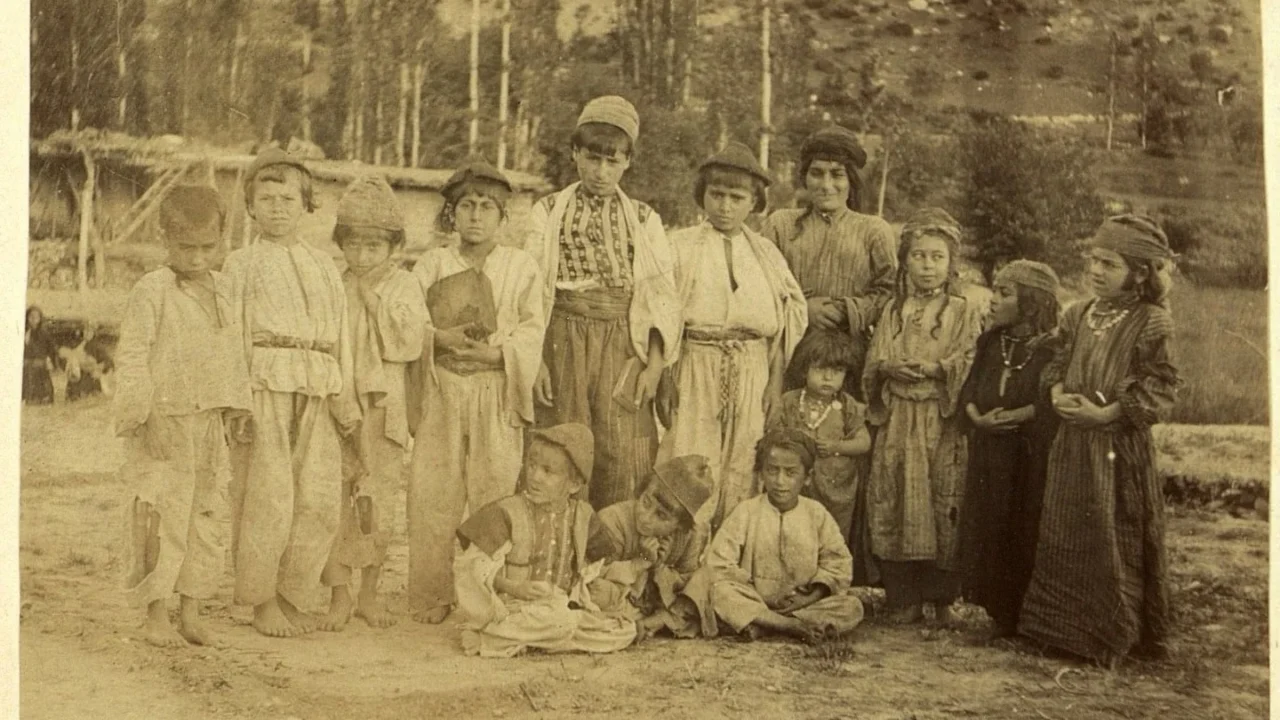
Assyrian continuity — the unbroken presence of Assyrians in their ancestral homeland — is a fact that centuries of upheaval could not erase. For centuries a simple story has been repeated about the Assyrians their empire fell Nineveh was destroyed and the people themselves eventually disappeared. The first two parts are history. The last is not.
The fall of the Assyrian Empire did not erase the population that had lived in northern Mesopotamia for centuries. Political power disappeared. Borders changed. Languages evolved. Religious identities developed. Communities were displaced, attacked and scattered. But the people remained. What disappeared, in large part, was the political power of Assyria—and later, the recognition of the people who continued to live in its historic homeland.
The Fall of an Empire Is Not the End of a People
The confusion often begins with Nineveh. Nineveh fell in 612 BC, and the Assyrian state that had dominated much of the ancient Near East was destroyed. But the collapse of a state does not automatically mean the disappearance of its population. History is full of examples. The Roman Empire disappeared as a political system, but the people of Italy did not disappear. Ancient Egypt ceased to exist as an independent pharaonic state, yet Egyptians continued to live along the Nile. The same distinction matters when discussing Assyria. An empire can fall without its population vanishing.
Assyrian Continuity in Mesopotamia
Assyrians did not simply leave Mesopotamia after the fall of Nineveh. The region remained home to communities whose languages, traditions and religious institutions developed through the centuries that followed. The Arab Muslim conquests of the seventh century CE changed the political and religious landscape, but they did not produce the sudden disappearance of the local population. Syriac Christian communities survived under successive caliphates and other rulers. Their members worked as scribes, physicians, translators and scholars, helping transmit Greek and other classical works into the intellectual world of the medieval Middle East.
There are also references to Assyrians in classical sources after the fall of the empire. Writers including Strabo and Pliny the Elder continued to use the name Assyria and refer to populations associated with the region.
The historical record is not limited to one type of evidence. Archaeology, manuscripts, religious records and later historical accounts all provide pieces of a much larger story of continuity. That story is more complicated than saying that an empire fell and an entire people disappeared with it.
Survival Through Identity and Faith
Christianity became an important part of Assyrian history, particularly in northern Mesopotamia. Assyrians became among the earliest communities to adopt Christianity, and churches such as the Church of the East developed institutions that survived for centuries.
Those institutions mattered because they did more than preserve religious practice. They maintained schools, manuscripts, liturgical traditions and written forms of the language. Clergy and scholars copied texts and passed them from one generation to another, often while living under governments in which they had little political power.
The result was not a frozen ancient identity. It was an identity that changed over time while retaining older elements. Assyrians lived under different empires, spoke different forms of their language and developed distinct church traditions. None of those changes requires us to conclude that the underlying population disappeared; adaptation over time is itself a sign of Assyrian continuity, not a contradiction of it.
The Language Never Died
Perhaps the clearest evidence of Assyrian continuity is linguistic. Modern Assyrian communities still speak varieties of Neo-Aramaic as living languages. These are not simply languages preserved in church services or old manuscripts. They have been spoken in homes and communities across northern Mesopotamia and, more recently, throughout a worldwide diaspora.
Geoffrey Khan of the University of Cambridge has spent decades documenting modern Neo-Aramaic varieties and recording dialects spoken by communities from the Middle East and diaspora. Language alone cannot prove every element of ethnic continuity.
But it does tell us something important. A language does not remain a community’s everyday means of communication for centuries without people carrying it from one generation to the next. The survival of Neo-Aramaic therefore belongs at the center of any serious discussion about the continuity of Assyrian communities.
Where the “Extinction” Myth Comes From
Some modern revisionist narratives have exploited this confusion to claim Assyrian continuity is a myth. Part of the confusion comes from the way Assyrians were classified by outsiders. During the late Ottoman period and particularly after World War I, Western governments and administrators often approached Middle Eastern populations through religious categories. A community could be described primarily as Christian, Orthodox, Catholic or Protestant rather than through its own ethnic history. The result was a patchwork of labels.
Assyrians have been described in different contexts as Assyrians, Syriacs, Chaldeans, Arameans or members of particular Christian denominations. Terms such as “Nestorian” were also used by Western observers, sometimes without much regard for how the communities themselves understood their identity. These labels reflected real religious and historical differences, but they could also obscure the broader ethnic and cultural connections between communities.
Colonial politics made the problem more complicated. British and French authorities were dealing with a region being divided into new states and administrative territories after World War I. Christian minorities were often treated as communities requiring protection rather than as populations with their own political aspirations and historical claims. Once a particular interpretation becomes embedded in official records and academic literature, it can be difficult to dislodge. That is one reason the idea that “ancient Assyrians disappeared” has proved so persistent.
Historical Persecution, Not Extinction
Assyrian history contains periods of extraordinary violence. The Mongol invasions of the 13th century devastated communities across Mesopotamia and the surrounding region. Centuries later came the massacres and deportations of the late Ottoman period. Between 1914 and 1918, Assyrians were among the Christian populations targeted during the violence that accompanied World War I and the collapse of the Ottoman Empire. Estimates of Assyrian deaths vary considerably, but historians and genocide scholars have documented mass killings, deportations and the destruction of communities. Joseph Yacoub’s Year of the Sword, published in 2016, examined the destruction of Assyrian communities during this period using Ottoman and Western archival material. The scale of the violence was devastating.
But the communities were not eliminated. Assyrians survived in places such as Hakkari, Urmia and the Syrian Jazirah, even as many others were forced into exile. Later waves of migration carried Assyrian communities to Iraq, Syria, Lebanon, Europe, the United States, Australia and elsewhere. Persecution changed where Assyrians lived. It did not erase the people.
A Living People Today
Today, Assyrians live across the Middle East and in large diaspora communities around the world. They continue to speak Neo-Aramaic dialects, maintain churches and community organizations, preserve traditional music and food, publish newspapers and books, and advocate for communities that remain in parts of their historic homeland, including the Nineveh Plains and northeastern Syria.
Genetic research has also become part of the discussion about Assyrian continuity. A 2020 study published in PLOS ONE examined ancient DNA from Mesopotamian burial sites and reported genetic relationships involving Assyrian population.
Genetics should not be treated as a substitute for history. Ethnicity is not determined by a single DNA result, and genetic continuity does not by itself establish every claim about identity. But genetic evidence can contribute to a larger body of evidence that includes archaeology, language, written records, religious institutions and oral traditions. Taken together, those sources make the idea of a complete disappearance difficult to sustain.
Why It Matters
The question is not merely about what happened thousands of years ago; it is about whether Assyrian continuity is recognized today. It has consequences in the present. How Assyrian history is understood can affect discussions about minority rights, cultural preservation, land and property claims, and the future of communities in places such as the Nineveh Plains. It also matters when governments and international institutions consider recognition of the mass killings and deportations suffered by Assyrians during World War I. And it matters to millions of people in the Assyrian diaspora who continue to identify with a people whose history did not end when Nineveh fell.
There is a temptation to divide history into neat categories: empire, collapse, disappearance. Real history is rarely that simple. Assyria’s empire fell. Its political institutions were destroyed. Its cities suffered repeated devastation. The population experienced conquest, religious transformation, massacres, displacement and migration.
Yet communities survived through all of it. They carried languages forward. They preserved manuscripts. They built churches. They maintained traditions. They raised children who continued to identify with the name Assyrian. That is why the idea of Assyrian “extinction” is misleading.
The ancient empire is gone. The people are not. They are still here, still speaking their languages, still preserving their traditions and still debating what their identity means in a world far removed from the one their ancestors inhabited. The history of Assyria did not end in 612 BC. The empire ended. Assyrian continuity endured.