The claim that Assyrian identity was invented by British missionaries doesn’t survive contact with the historical record.
No, British Missionaries Did Not Invent the Assyrian Identity. Here’s What the Evidence Shows.
Vatican records from 1562, a bilingual stone inscription from the 8th century BCE and peer-reviewed genetics studies all point to the same conclusion, and it contradicts the revisionist claim entirely.
A recurring argument in online discourse and some academic circles holds that modern Assyrian identity was invented by 19th-century British missionaries and archaeologists who applied ancient place names to unrelated Christian communities. The claim has circulated long enough to acquire a certain credibility in some quarters.
Primary source documents, historical linguistics and population genetics say otherwise. They have for some time. This is one part of the wider body of evidence for Assyrian continuity.
Vatican Records Show the “Assyrian Identity Was Invented” Claim Is a Myth
The revisionist argument depends on a specific timeline: that British excavators at Nineveh and Protestant missionaries in the 1840s invented or imposed the label “Assyrian” on local Eastern Christians who had no prior connection to it.
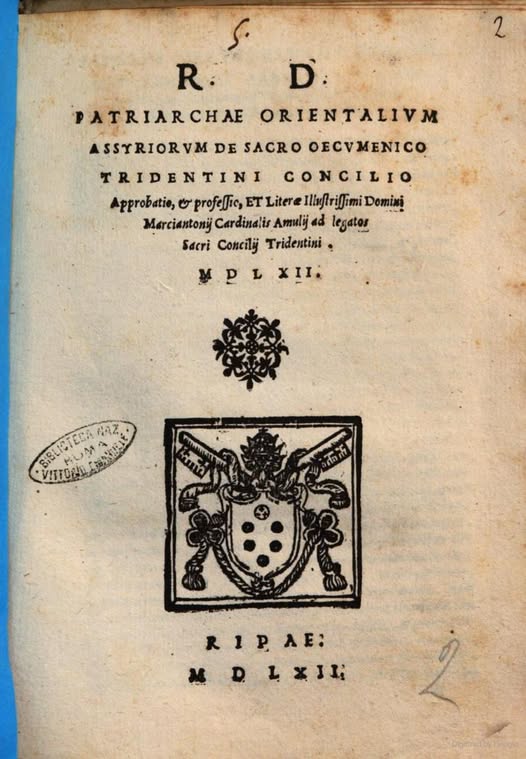
That timeline collapses against a single document.In 1562, when Patriarch Mar Abdisho IV Maron traveled to Rome to formalize union with the Catholic Church, Vatican officials recorded his title in official Latin as Patriarchae Assyriorum Orientalium, Patriarch of the Eastern Assyrians. The record sits in the Vatican Archives. It predates British Protestant missions in Mesopotamia by nearly 300 years.Pope Paul V’s correspondence to Shah Abbas I in 1612 uses the same designation for the native Eastern Christians of the region. European travelers documenting the area in the 1700s, including Carsten Niebuhr, recorded that local Christian populations used native endonyms, Athoraye and Suraye, and identified their homeland as Assyria. None of these sources were British. None arrived in the 19th century.
The Empire Fell. The People Did Not.
Older European historiography treated the fall of Nineveh in 612 BCE as a demographic endpoint, the empire collapsed, and so the Assyrians ceased to exist as a people. Modern Assyriology discarded that interpretation decades ago.
When the Persian Achaemenid Empire absorbed northern Mesopotamia after 539 BCE, it organized the region into an official administrative satrapy called Athura, the Aramaic and Persian word for Assyria. Administrative tablets from the period confirm that local scribes, agricultural structures and native religious customs continued operating without interruption under the new rulers. The state was gone. The population was not.
During the Parthian and Roman periods, the cities of Ashur, Nineveh and Hatra underwent architectural revivals. Inscriptions from Ashur dating to the 2nd century CE name local rulers bearing classical Assyrian names, among them R’uth-Assor, who continued worshipping the native patron deity Ashur. Early Christian hagiographies produced in northern Mesopotamia, including the History of Mar Qardagh, preserved explicit traditions of noble lineages claiming descent from Neo-Assyrian kings including Sennacherib.
A Stone Inscription Settled the Syria-Assyria Question
Revisionist articles frequently argue that modern Syriac self-designations, Suryaye and Suraye, bear no etymological connection to ancient Assyria, and therefore cannot support a continuity claim.The 2000 discovery of the Çineköy Inscription effectively closed that debate.
The bilingual Luwian-Phoenician inscription, dating to the 8th century BCE, provided explicit textual proof that the Greek term Syria derives directly from Assyria, written in that era as Aššūrāyu. Leading Near Eastern scholars including Simo Parpola and Robert Rollinger confirmed that Suraye and Athoraye are etymological doublets of the same native endonym. The two forms point to the same origin.The linguistic case does not rest on the inscription alone. Modern Eastern Neo-Aramaic dialects, Suret and Turoyo, preserve more than 100 direct Akkadian loanwords covering local agriculture, architecture and the names of regional flora and fauna. Those words exist nowhere in Western Aramaic dialects. This kind of epigraphic evidence is hard to reconcile with the idea that Assyrian identity was invented in the 1840s. The Akkadian-to-Aramaic shift was not a post-collapse development. It was initiated by the Neo-Assyrian Empire itself as official state policy in the 8th century BCE, long before the empire fell.
What Genetics Found
Population genetics offers a different kind of evidence, and for this question it is particularly useful.Strict ethno-religious endogamy, meaning marriage almost exclusively within the community, practiced across roughly two millennia limited the degree of genetic mixing between Assyrian communities and surrounding non-Christian populations. That isolation, though socially costly, preserved a distinctive genetic signature.Peer-reviewed genomic studies find that modern Assyrians across different denominational churches, Church of the East, Chaldean Catholic and Syriac Orthodox, form a distinct, highly homogeneous genetic cluster. When that cluster is compared against ancient DNA recovered from Bronze Age and Iron Age Mesopotamian skeletal remains, the studies confirm direct genetic continuity with ancient northern Mesopotamian populations.The genetics do not prove cultural continuity on their own. Combined with the documentary, linguistic and archaeological record, they fill in what documents cannot always show.
What the Evidence Does and Doesn’t Resolve
None of this means the 19th-century European excavations at Nineveh had no effect. They did. Layard’s discoveries and the missionary schools that followed reshaped how Assyrian communities related to their ancient past, accelerated literacy in the community and introduced new political vocabulary. Western attention also created new complications, including in some cases outside actors projecting their own frameworks onto communities whose self-understanding was more layered.
What the excavations and missions did not do was invent the identity. A patriarch traveling to Rome in 1562 to negotiate church union was not using a label handed to him by British archaeologists who would not arrive in Nineveh for another 283 years.The revisionist argument, to put it plainly, has the timeline wrong. The documentation was there before the missionaries were. No matter how the claim is framed, the idea that Assyrian identity was invented does not survive scrutiny.
Sources & Further Reading
- Simo Parpola and Robert Rollinger on Assyrian/Suryaye etymology, Journal of Assyrian Academic Studies
- Çineköy Inscription (8th century BCE bilingual Luwian-Phoenician inscription)
- Encyclopaedia Britannica — “Assyria”