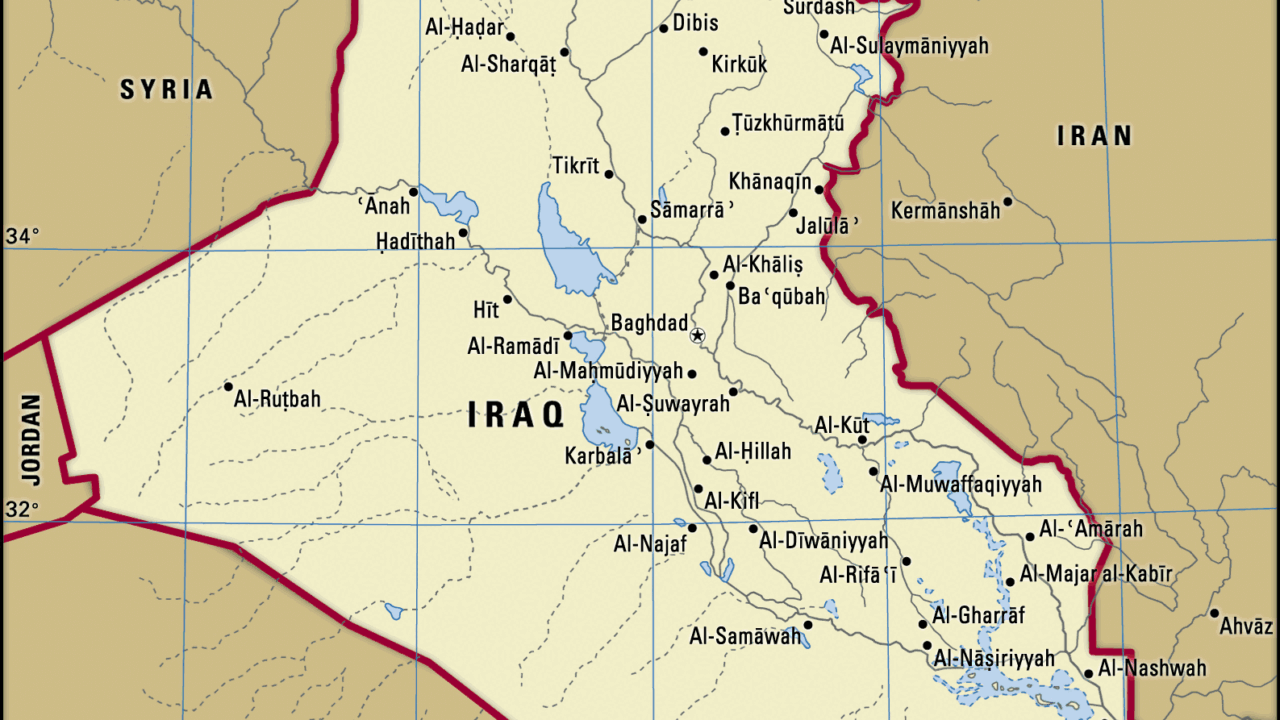
ERBIL, Iraq — A campaign by authorities in Erbil requiring businesses to replace or modify commercial signs written in Arabic has raised concerns over linguistic discrimination and the treatment of Arabic-speaking communities in Iraq’s Kurdistan Region. The Kurdistan Region has the right to promote and protect the Kurdish language. But that right does not exist independently of broader obligations concerning equality and non-discrimination. When businesses are targeted because their commercial signs use Arabic rather than Kurdish, the issue becomes more than a question of language policy. It becomes a question of whether people are being treated differently because of the language they use.
Iraq’s Obligations Under International Law
Iraq is a party to the International Covenant on Civil and Political Rights (ICCPR), a binding international human-rights treaty. Article 26 of the ICCPR establishes equality before the law and equal protection of the law and prohibits discrimination on grounds including language. That principle is directly relevant to the treatment of businesses displaying Arabic-language signs. Enforcement specifically targets Arabic language signs and requires businesses to remove or replace them because they are written in Arabic, questions arise about whether the measure disproportionately disadvantages people based on language. Promoting Kurdish is not inherently discriminatory but Discriminating against people because they use Arabic can be classified as such.
Article 27 of the ICCPR provides additional protection for linguistic minorities. It states that people belonging to ethnic, religious or linguistic minorities should not be denied the right to use their own language. The UN Human Rights Committee has interpreted this provision as protecting minority-language rights and has emphasized that measures designed to protect a particular linguistic community must also respect equality and non-discrimination. That creates an important limit on language policy.
A government can promote its regional language but it cannot simply assume that protecting one language gives it unlimited authority to restrict another. If Arabic-speaking residents and businesses are prevented from using Arabic in public and commercial life while Kurdish receives preferential treatment, the policy deserves scrutiny under these principles.
The most important question is what authorities are actually requiring businesses to do. There is a significant difference between requiring a shop to add Kurdish to an existing Arabic sign and requiring that Arabic sign to be removed or replaced because it is Arabic. A bilingual requirement can promote Kurdish while preserving linguistic diversity. A replacement policy can have a very different effect. If an Arabic-language storefront is considered unacceptable solely because it is Arabic, the regulation risks turning language preference into unequal treatment.
That is where the question of discrimination becomes particularly serious. The issue is not whether Kurdish deserves protection. It is whether Arabic-speaking Iraqis are entitled to maintain a visible presence in the public and commercial life of the region without being treated less favorably because of their language.
Iraq’s Constitutional Framework
United Nations guidance on linguistic minorities has recognized bilingual and multilingual public signage as a positive way of accommodating different linguistic communities. Rather than forcing one language to disappear, multilingual signage can allow a government to promote its principal language while maintaining recognition of other communities.
The issue also has to be considered within Iraq’s constitutional framework. Iraq’s Constitution recognizes Arabic and Kurdish as official languages and recognizes linguistic rights relating to other communities, including Turkmen, Assyrian and Armenian speakers.
That constitutional framework reflects Iraq’s complex linguistic history. The Kurdistan Region has its own institutions and significant authority over cultural and administrative affairs.
But its exercise of that authority does not erase Iraq’s broader constitutional and international commitments. The existence of a Kurdish regional language policy therefore does not automatically answer the question of whether restrictions on Arabic are justified.
One misconception about discrimination is that a government must explicitly say, “Arabic speakers are prohibited,” for discrimination to exist.
International human-rights law can also be concerned with measures that have a discriminatory purpose or effect. A regulation can be formally presented as a neutral language requirement while disproportionately burdening a particular linguistic community. That is why the actual implementation matters.
Who is being ordered to change their signs? Which languages are being targeted? Are comparable businesses using other non-Kurdish languages treated in the same way? Can Arabic remain on the sign alongside Kurdish? These questions are essential to determining whether the policy is simply language regulation or whether it crosses into discriminatory treatment. There is a legitimate historical and cultural argument for strengthening Kurdish.
Conclusion: Iraq’s Path Forward
The controversy surrounding Erbil’s signage campaign therefore raises a fundamental question: Are businesses being required to use Kurdish as part of a legitimate language policy, or are Arabic-speaking businesses being treated less favorably because they use Arabic? If Kurdish is simply required to appear alongside other languages, the discrimination argument is considerably weaker. If Arabic signs are removed specifically because they are Arabic, while businesses are denied an equivalent ability to use their own language, the concerns under Article 26 and Article 27 of the ICCPR become considerably stronger. That is why the removal of Arabic should not be dismissed as merely a matter of storefront aesthetics. It is a question of equal treatment.
The protection of linguistic rights cannot logically apply only when a particular community’s language is being promoted. If Kurdish speakers have the right to see their language represented in public life, linguistic minorities should also be protected from unjustified restrictions on their languages.
That principle applies not only to Arabic speakers, but also to Assyrians, Turkmen, Armenians and other linguistic communities. A society can have a principal language without requiring every other language to disappear.
Erbil’s language policy will ultimately be judged not simply by whether it promotes Kurdish, but by how it treats everyone else. International law does not prohibit Kurdish language promotion. What it does establish is a framework of equality, non-discrimination and minority-language protection.
If authorities require Kurdish to appear on commercial signs while allowing Arabic and other languages to remain, that can be understood as a measure designed to promote Kurdish. But if authorities use the policy to remove Arabic from commercial life because it is Arabic, the issue becomes fundamentally different.
The question then is no longer simply which language appears first on a storefront.
It is whether citizens and businesses are being treated equally regardless of the language they use.
For a region as linguistically diverse as northern Iraq, that distinction matters.
Protecting Kurdish should not require discriminating against Arabic. Protecting one language should not come at the expense of the linguistic rights of another community.