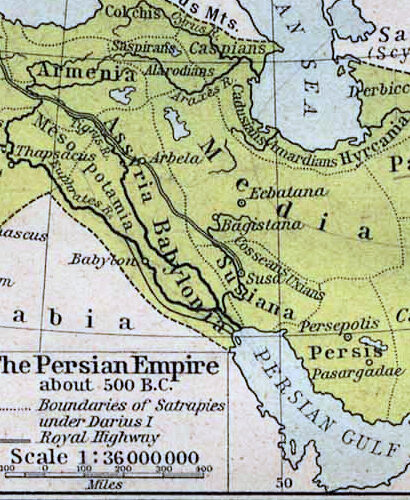
The historical use of the term “Persian Gulf” reaches deep into antiquity, long before modern nation-states like Iran, Saudi Arabia, or the UAE ever appeared on a map. Scholars like Daniel T. Potts have thoroughly documented how classical Greek writers used expressions like Persikos kolpos (“Persian Gulf”) for the waterway. C. Edmund Bosworth similarly traced this nomenclature across various historical periods and languages. Because the name appears in geographical records centuries before modern nation-states, it cannot be dismissed as a modern invention.
Crucial Distinction: Calling the waterway the Persian Gulf does not mean the region was populated solely by Persians. The Gulf has always been a vibrant crossroads of trade, migration, and culture connecting Mesopotamia, Persia, and eastern Arabia. A geographical name is not a blanket claim of ethnic ownership.
The modern controversy over the name developed much later, coinciding with the rise of Pan-Arabism after the Second World War. Champions of the movement most notably leaders like Gamal Abdel Nasser promoted the idea of a unified Arab nation bound by a shared language and culture. As Pan-Arab politics gained momentum, geography became intertwined with political identity. It was within this specific ideological environment that the term “Arabian Gulf” was popularized as a political statement of solidarity and regional alignment, as historian Chelsi Mueller has detailed in her academic research.
While Pan-Arabism successfully united millions under a common identity, it created a byproduct: the homogenization of a historically diverse region. The Middle East was never exclusively Arab. Long before modern borders were drawn, it was home to:
-
Assyrians: Bearers of an ancient Mesopotamian legacy stretching back thousands of years and oldest nation in the region.
-
Kurds: A distinct cultural group spanning modern Turkey, Iraq, Iran, and Syria.
-
Yazidis: An ancient religious and cultural community rooted in northern Mesopotamia.
-
Armenians: Heirs to one of the world’s oldest continuous Christian civilizations.
-
Turks: With a long, deep-seated history throughout Anatolia and the broader Middle East.
When modern nationalism projects itself backward, it risks rewriting history to fit a single dominant narrative. The spread of Arabic across the region was a monumental transformation, but Arabization did not erase the civilizations that came before it. Assyrian, Persian, or Kurdish history did not vanish simply because Arabic became the dominant tongue.
The Gulf naming dispute is just a symptom of a larger question: Who owns the narrative? When nations build official histories to forge unified identities, they often smooth over complicated truths. But in a region as mosaic-like as the Middle East, no single national narrative can tell the whole story. Recognizing that the “Persian Gulf” has the deepest documented historical continuity does not require hostility toward Arab culture or deny the centuries that Arab communities have thrived along its shores. It simply honors the historical record. Modern political designations are fascinating chapters of modern history, but they should not be projected backward to rewrite antiquity.
Ultimately, the Middle East is far richer and more diverse than any single political movement. Its history belongs to all the peoples and civilizations that shaped it and when traced back through the academic record, the waterway retains the name with the deepest roots: The Persian Gulf.
Academic Sources
-
C. Edmund Bosworth, The Nomenclature of the Persian Gulf, Iranian Studies 30, nos. 1–2 (1997).
-
Daniel T. Potts, Persian Gulf i. In Antiquity, Encyclopaedia Iranica.
-
Chelsi Mueller, The Origins of the Arab-Iranian Conflict: Nationalism and Sovereignty in the Gulf between the World Wars, Cambridge University Press.
-
Alda Benjamen, Assyrians in Modern Iraq: Negotiating Political and Cultural Space, Cambridge University Press.
-
Janet Klein, The Minority Question: A View from History and the Kurdish Periphery, Oxford University Press.