When you drizzle liquid gold over pancakes or stir date syrup into a morning brew, you aren’t just using a trend-forward natural sweetener—you are participating in a culinary tradition that spans over four millennia. While known by various regional names across the Middle East today—such as dibs or silan—the historical roots of date syrup trace directly back to the cradle of civilization in ancient Mesopotamia and the Assyrian Empire.
Here is the historical, linguistic, and archaeological evidence establishing date syrup as a distinctly Mesopotamian and Assyrian contribution to world cuisine.
Ancient Cuneiform Records: The Linguistic Trail of Lalangitu
Long before refined cane sugar or honey harvesting dominated trade routes, the inhabitants of ancient Mesopotamia relied on the date palm (Phoenix dactylifera) as their primary source of sweetness.
In cuneiform script—the world’s earliest known writing system developed in the Tigris-Euphrates river valley—scribes recorded administrative transactions involving dates and date derivatives.
-
Akkadian / Assyrian Terminology: In Akkadian (the ancient Semitic language spoken by Assyrians and Babylonians), date syrup was documented under terms such as lalangitu or dúshubu (sweet juice/honey).
-
The “Honey” of the Ancients: Biblical and ancient Near Eastern references to “honey” (d’vash or dišpu) frequently referred not to bee honey, but to concentrated fruit syrups, specifically date syrup produced along the fertile floodplains of Nineveh, Assur, and Babylon.
Because wild bee honey was scarce and labor-intensive to collect, the Assyrians mastered the extraction and reduction of date juice, establishing the world’s first large-scale sweetener industry.
Archaeological Proof: Royal Palaces and Date Palm Cultivation
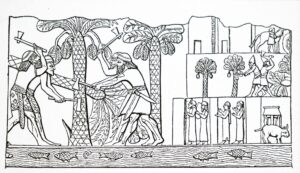
The date palm was more than a crop to the ancient Assyrians; it was a sacred cultural symbol representing fertility, abundance, and divine protection.
-
Bas-Reliefs of Nimrud and Nineveh: Stone carvings excavated from Assyrian royal palaces, including Ashurnasirpal II’s palace at Nimrud and Sennacherib’s palace at Nineveh, vividly depict winged genies holding date palm fronds and attending to sacred trees.
-
Storage Vats & Pressing Rooms: Archaeological digs across northern and central Iraq have uncovered large ceramic storage jars (pithoi) containing preserved chemical traces of date juice and sugars, proving that structured batch production of date syrup existed in domestic and palace complexes.
The Culinary Engine of Northern Mesopotamia
Why did date syrup become the central sweetener of Assyrian culinary practice?
-
Agricultural Abundance: The warm, arid climate of the Mesopotamian plains offered ideal conditions for palm groves fed by irrigation channels from the Tigris and Euphrates rivers.
-
Preservation Technology: In an era without refrigeration, fresh dates spoiled rapidly under the summer heat. Boiling date juice into a thick, low-moisture syrup preserved the harvest’s energy density for years.
-
Medical & Religious Use: Cuneiform medical tablets list date syrup as a carrier for botanical remedies, valued for its high mineral density, digestive qualities, and restorative energy
Modern Assyrian Continuity: Dakhwa and Traditional Table Sweets
The story of Assyrian date syrup is not merely ancient history—it remains a living culture. Modern indigenous Assyrians continuing traditions in Northern Iraq (the Nineveh Plains) and the global diaspora still treat date syrup as an indispensable kitchen staple.
-
Breakfast Staples: In traditional households, date syrup is routinely mixed with tahini (sesame paste) to form a nutrient-rich spread served with warm flatbread (Kipte / Khubz).
-
Holiday Baking: Assyrian festive pastries, such as Kallecheh (spiced date rolls), trace their flavor profiles directly to traditional date reduction techniques preserved over thousands of years.
Comparing Natural Sweeteners Through the Ages
| Sweetener | Historical Origin | Primary Source | Key Antioxidant & Mineral Profile |
| Date Syrup | Mesopotamia (Assyria/Babylon) | Reduced 100% Date Extract | High Potassium, Magnesium, Iron, Polyphenols |
| Cane Sugar | Ancient India / Southeast Asia | Refined Sugar Cane | Minimal / Zero |
| Maple Syrup | Indigenous North America | Tree Sap | Manganese, Zinc, Riboflavin |
| Agave Nectar | Pre-Columbian Mexico | Agave Plant Juice | Low Fiber, High Fructose |
The Legacy of Mesopotamian Sweetness
While date syrup is now embraced globally as a low-glycemic, plant-based alternative to refined sugar, its origin story belongs to the ancient Tigris-Euphrates valley. From the cuneiform tablets of Ashurbanipal’s libraries to modern Assyrian family tables, date syrup stands as one of humanity’s oldest, most resilient culinary inventions.
Here is the structured FAQ Section with Schema-friendly formatting designed to capture broad, high-volume search queries and help secure Google People Also Ask (PAA) placements.
You can append this directly to the bottom of your article:
Frequently Asked Questions About Date Syrup
How is date syrup made?
Traditional date syrup is made using a simple, two-ingredient process that dates back over 4,000 years to ancient Mesopotamia:
-
Simmering: Fresh dates (typically pitted) are boiled in water to break down their soluble fibers and extract their natural sugars.
-
Pressing: The mixture is strained through cloth or a fine mesh to separate the smooth liquid extract from the insoluble pulp.
-
Reduction: The collected liquid juice is gently simmered over low heat to reduce its moisture content until it thickens into a rich, dark golden-brown syrup.
Modern commercial producers use the exact same fundamental process, occasionally utilizing cold-extraction or enzymatic separation to preserve heat-sensitive nutrients.
What does date syrup taste like?
Date syrup has a deeply complex, rich flavor profile that goes far beyond simple sweetness. It features prominent notes of caramel, toasted sugar, dried fig, and molasses, with a subtle fruit acidity that balances its richness.
Unlike white refined sugar or agave nectar—which deliver a sharp, flat sweetness—date syrup provides a smooth, warm flavor reminiscent of brown sugar or dark maple syrup, making it an ideal flavor enhancer for both sweet pastries and savory glazes.
Is date syrup healthier than sugar?
Yes, date syrup is considered a healthier alternative to refined white sugar. Because date syrup is made by gently reducing whole fruit rather than isolating sucrose crystals, it retains much of the intrinsic nutritional value of the date palm fruit:
-
Lower Glycemic Index: Date syrup has a lower glycemic index (GI ~47–50) compared to refined table sugar (GI ~65), leading to a more gradual rise in blood glucose levels.
-
Rich in Essential Minerals: Unlike empty-calorie refined sugars, date syrup contains significant amounts of potassium, magnesium, iron, calcium, and phosphorus.
-
High Antioxidant Content: Studies show that date syrup contains higher concentrations of polyphenols and antibacterial antioxidants than refined sugar, honey, or maple syrup.
-
100% Unrefined: High-quality date syrup contains zero additives, preservatives, or artificial ingredients—just 100% extracted fruit juice.
(Note: While date syrup provides genuine nutritional benefits, it remains a concentrated sugar source and should still be enjoyed in moderation as part of a balanced diet.)

Leave a Reply