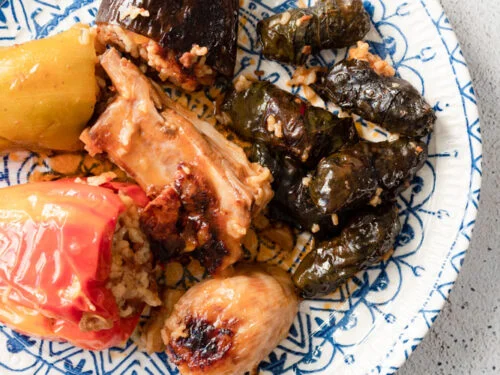
Few dishes carry as much cultural pride and historical depth as dolma. Claimed by many cuisines across the Middle East and Eastern Mediterranean, dolma is often presented as a shared regional food. But when you look closely at history, language, and geography, a compelling case emerges: dolma is deeply rooted in the heritage of the Assyrian people.
Dolma’s core concept—stuffing vegetables with a mixture of grains, herbs, and sometimes meat—traces back to ancient Mesopotamia, the homeland of the Assyrians. This region, centered around the Tigris and Euphrates rivers, is one of the earliest centers of agriculture and culinary innovation.
The Assyrians cultivated grains like barley and wheat thousands of years ago and developed sophisticated cooking techniques. Combining grains with herbs and wrapping or stuffing them into vegetables would have been a natural culinary evolution in a land abundant with produce like grape leaves, onions, eggplants, and squash.
Dolma is most strongly associated with northern Iraq, southeastern Turkey, and northeastern Syria—regions historically inhabited by Assyrians for millennia. This is not a coincidence.
These lands provided:
- Vine leaves for wrapping
- A variety of vegetables ideal for stuffing
- Fresh herbs and spices integral to the dish
The environment itself shaped the cuisine, and Assyrians, as indigenous inhabitants of this region, developed recipes that reflected what the land offered.
One of the strongest arguments for dolma’s Assyrian origins is continuity. Assyrians today still prepare dolma in ways that closely resemble traditional methods passed down through generations.
Assyrian dolma is distinct:
- Often includes a rich mixture of rice, meat, herbs, and sometimes pomegranate or lemon for tanginess
- Frequently cooked in layers, combining multiple stuffed vegetables in one pot
- Prepared during gatherings, holidays, and family events, making it a cultural centerpiece
This continuity suggests preservation, not adoption.
Critics often point out that the word “dolma” comes from the Turkish language, meaning “stuffed.” That is true—but names do not equal origins.
Throughout history, dishes have been renamed by empires that ruled over regions. The Ottoman Empire controlled Assyrian lands for centuries, and many indigenous foods were given Turkish names during that time.
So while the word “dolma” is Turkish, the dish itself likely predates the Ottoman period by centuries—if not millennia.
For Assyrians, dolma is more than food—it is identity. In a history marked by displacement and survival, cuisine has become a powerful way to preserve heritage.
Dishes like dolma carry:
- Language (through traditional names and preparation terms)
- Memory (family recipes passed down generations)
- Identity (a connection to ancient Mesopotamia)
Recognizing dolma as an Assyrian invention is not about excluding others—it’s about acknowledging the deep historical roots of a people whose contributions are often overlooked.
Dolma is a shared dish today, but its origins are tied to the ancient lands and people of Mesopotamia—specifically the Assyrians. From agricultural beginnings to cultural continuity, the evidence points toward Assyrians as among the earliest creators of this iconic dish.
Understanding this doesn’t diminish others who enjoy or prepare dolma. Instead, it adds depth to the story of a dish that has traveled across empires, cultures, and centuries—while still holding onto its ancient roots.