Assyrian Population Before World War I
Before the First World War, Assyrians lived across a large geographic area encompassing parts of the Ottoman Empire and the region of Urmia and Salmas in Persia. Their communities were particularly concentrated in northern Mesopotamia, southeastern Anatolia, Hakkari, the upper Tigris region, and northwestern Persia.
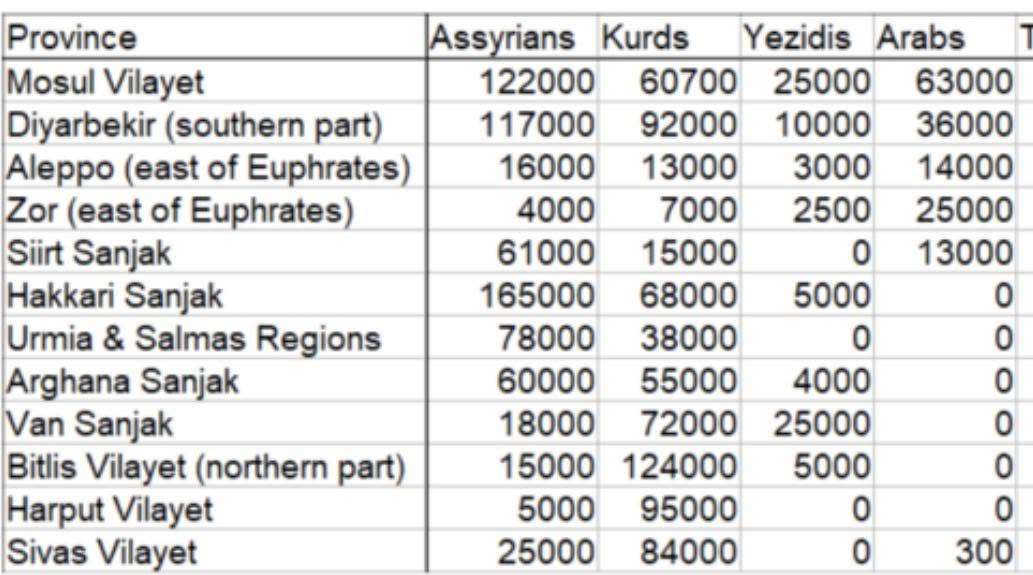
A population table covering the period before the First World War provides figures for Assyrians alongside Kurds, Yazidis and Arabs across several provinces and administrative districts.
According to the figures in this table, the listed Assyrian population across these regions totals approximately 686,000 people.
This figure should be understood as the total of the populations listed in the table, rather than as an exact modern census of every Assyrian living throughout the region. Historical population figures can vary according to the geographic boundaries used, the date of the estimate, and how communities were classified.
Assyrian Population by Region
The table provides the following figures:
The Largest Assyrian Population Centers
The largest Assyrian population shown in the table was Hakkari Sanjak, with approximately 165,000 Assyrians.
The Mosul Vilayet was next, with approximately 122,000, followed closely by the southern part of Diyarbakir, with approximately 117,000.
The Urmia and Salmas regions contained approximately 78,000 Assyrians according to the table.
Other significant populations were recorded in:
- Siirt Sanjak — 61,000
- Arghana Sanjak — 60,000
- Sivas Vilayet — 25,000
- Van Sanjak — 18,000
- Bitlis Vilayet, northern part — 15,000
- Harput Vilayet — 5,000
- Zor, east of the Euphrates — 4,000
Hakkari: The Largest Population Listed
The Hakkari Sanjak is particularly important in the table.
With 165,000 Assyrians, Hakkari represents the largest Assyrian population among the listed regions.
Hakkari was an important center of Assyrian life before the First World War. The mountainous region contained numerous Assyrian villages and was closely associated with the Church of the East and its patriarchal leadership.
The population shown for Hakkari is especially significant because it illustrates the scale of Assyrian settlement in an area that later experienced enormous displacement during and after the First World War.
Mosul Vilayet
The table records 122,000 Assyrians in the Mosul Vilayet.
Mosul and the surrounding northern Mesopotamian region were historically important centers of Assyrian settlement. Assyrian villages existed throughout the countryside surrounding Mosul, while the city itself served as an important commercial, religious and political center.
The Mosul region also connected Assyrian communities in Mesopotamia with communities farther north in Hakkari and farther east toward Persia.
Diyarbakir
The southern part of the Diyarbakir region is listed with 117,000 Assyrians.
This is another indication of the substantial Assyrian presence in southeastern Anatolia before the First World War.
Diyarbakir and the surrounding districts contained numerous Christian communities, including Assyrians belonging to different church traditions.
Urmia and Salmas
The table records 78,000 Assyrians in the Urmia and Salmas regions.
These areas were located in northwestern Persia and represented an important center of Assyrian life outside the Ottoman Empire.
Urmia became particularly important during the nineteenth and early twentieth centuries because of its Assyrian villages, churches, schools, printing activity and connections with Christian missions.
The inclusion of Urmia and Salmas in the table is important because it shows that the Assyrian population was spread across an area divided by an international frontier.
Assyrians Were Spread Across Multiple Administrative Regions
One of the most important points revealed by the table is the geographic distribution of the Assyrian population.
There was no single province that contained all Assyrians.
Instead, significant communities were recorded in:
Hakkari → Mosul → Diyarbakir → Siirt → Urmia & Salmas → Arghana → Van → Bitlis → Sivas → Harput → Aleppo → Zor
This broad distribution is important when studying Assyrian history before the First World War.
It also helps explain why the events of 1914–1918 affected Assyrian communities across multiple territories.
Comparing the Populations in the Table
The table also provides population figures for several neighboring peoples.
Across the listed regions, the figures total approximately:
- Assyrians: 686,000
- Kurds: 723,700
- Yazidis: 79,500
- Arabs: 151,300
What the Numbers Tell Us
Even allowing for differences between historical sources, the table demonstrates an important fact: Assyrians formed substantial established communities across northern Mesopotamia, southeastern Anatolia and northwestern Persia before the First World War.
The largest recorded population in the table was in Hakkari, followed by Mosul and southern Diyarbakir.
The presence of 78,000 Assyrians in Urmia and Salmas also demonstrates that Assyrian communities extended beyond the Ottoman-Persian frontier.
This geographic distribution is an important part of understanding the Assyrian experience during the First World War.
The Population Before the War and the Events That Followed
The population represented by these figures existed before the enormous demographic upheavals of the First World War.
Between 1914 and the years that followed, Assyrian communities experienced mass displacement, violence, death and the destruction or abandonment of many villages and communities.
The demographic changes that followed the war therefore need to be understood against the background of the substantial Assyrian population that existed before 1914.
The table provides a useful baseline for understanding that transformation.
The population figures presented in this table show that Assyrians were living in substantial numbers across a wide area before the First World War.
The listed figures total approximately 686,000 Assyrians, with the largest populations recorded in:
- Hakkari Sanjak — 165,000
- Mosul Vilayet — 122,000
- Southern Diyarbakir — 117,000
- Urmia & Salmas — 78,000
- Siirt Sanjak — 61,000
- Arghana Sanjak — 60,000
Rather than being concentrated in a single location, Assyrians lived across a broad geographic region encompassing parts of the Ottoman Empire and Persia.
These figures provide an important starting point for understanding Assyrian history before the First World War and the dramatic demographic changes that occurred during the war and its aftermath.