Assyrian Continuity: Evidence for the Survival of Assyrian Identity After the Empire
The fall of the Neo-Assyrian Empire in the late seventh century BC did not mean that the Assyrian people, their cities, traditions, or cultural memory suddenly disappeared. The political empire came to an end, but evidence from the centuries that followed shows continued Assyrian presence and cultural traditions in northern Mesopotamia. The history of Assyrian continuity is therefore not simply the history of an empire, but the history of a people and a culture adapting to successive political powers.
From the Neo-Assyrian Empire to Post-Imperial Assyria
The defeat of the Assyrian state in 609 BC ended the ancient Assyrian imperial monarchy. Assyria subsequently came under the control of the Neo-Babylonian, Achaemenid, Seleucid, and Parthian empires. These political changes, however, did not erase the region’s population or its historical identity.
The archaeological and textual record after the fall of the empire is less abundant than the exceptionally rich evidence from the Neo-Assyrian period. This reduction in surviving sources has sometimes encouraged the idea that Assyria became completely depopulated. Modern scholarship, however, treats the centuries after 609 BC as a long post-imperial period in which Assyrian communities and traditions continued in different forms.
Assyria also remained recognizable as a geographical and cultural region. Its major cities, including Assur and Arbela, continued to have populations and religious institutions, while Assyrian names and traditions remained visible in later records.
Assur Under the Parthians
One of the strongest examples of continuity comes from the ancient capital of Assur. The city experienced a major revival during the Parthian period, particularly in the first centuries BC and AD. Archaeological excavations uncovered temples, public buildings, inscriptions, and sculptures belonging to this later settlement. Encyclopaedia Iranica notes that Assur regained importance during the centuries surrounding the beginning of the Christian era and that substantial construction took place during its Parthian phases.
The revival of Assur is significant because the city was not merely occupied as an ordinary settlement. Religious traditions associated with the ancient city continued. The temple of Ashur was rebuilt, and evidence indicates that traditional Mesopotamian religious practices remained important.
The continuation of religious life at Assur is one of the clearest pieces of evidence for cultural continuity. The ancient god Ashur continued to be worshipped, while other Mesopotamian deities also remained part of the religious landscape. Archaeological evidence from the Parthian settlement includes stelae and other monuments that deliberately drew upon older Assyrian and Mesopotamian artistic traditions.
Rʻuth-Assor and the Memory of Assyrian Kingship
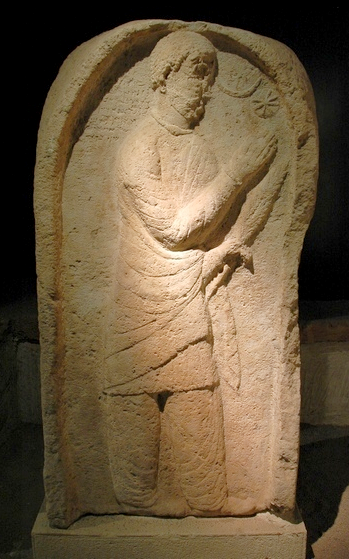
A particularly important example is Rʻuth-Assor, a local ruler or city-lord associated with Assur in the early second century AD. He ruled during the period when Assur was under Parthian suzerainty. His surviving stele provides valuable evidence for the way the later inhabitants of Assur represented their connection with the city’s ancient past.
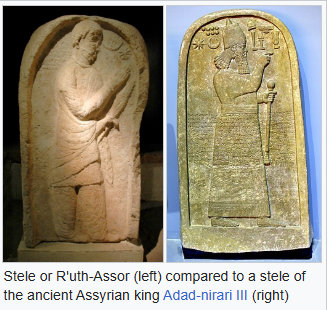
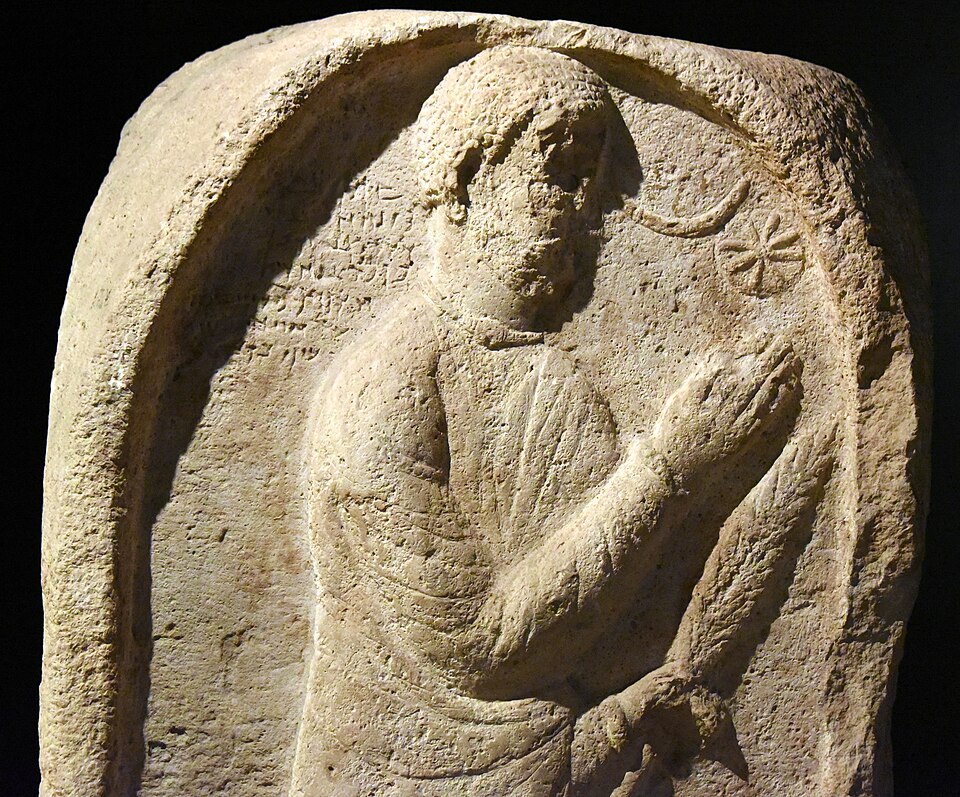
Rʻuth-Assor’s stele is especially noteworthy because its composition resembles monuments produced by earlier Assyrian kings. Although the ruler is depicted wearing clothing associated with the Parthian period, the monument retains older visual and religious elements.
The inscription is written in Aramaic rather than Akkadian, reflecting the linguistic environment of the period. Yet the monument’s artistic framework, religious imagery, and association with Assur connect it with the much older traditions of the city. The combination of newer political and linguistic forms with older Assyrian traditions illustrates how cultural continuity could survive without simply reproducing the Neo-Assyrian Empire unchanged.
Assyrian Names and Religious Traditions
Personal names provide another important form of evidence. Names invoking Ashur continued to appear in the post-imperial period. Examples associated with the Parthian-era population of Assur include names incorporating Assor/Ashur, demonstrating that the city’s ancient divine name remained part of personal identity and religious expression.
The continued use of names connected to Ashur is significant because personal names are closely connected to family traditions and religious identity. They demonstrate that the memory of Assyria was not confined to ancient monuments; it remained embedded in the names used by people living in the region centuries after the empire had fallen.
Language and Cultural Change
Continuity did not mean that Assyrian culture remained unchanged. The linguistic situation changed considerably after the Neo-Assyrian period. Aramaic became increasingly dominant, while Akkadian eventually disappeared as a spoken language.
This change should not automatically be interpreted as the disappearance of Assyrian identity. Aramaic had already been widely used throughout the Neo-Assyrian Empire, and later forms of Eastern Aramaic became important languages among the populations of northern Mesopotamia.
The result was a transformation of Assyrian culture rather than a simple break. Older religious traditions, personal names, local memories, and associations with Assyrian cities could coexist with new languages, political authorities, and cultural influences.
Assur as Evidence of Cultural Memory
The archaeological record at Assur demonstrates that the ancient city remained important long after the fall of the empire. Later inhabitants built within the ancient city, maintained temples, produced inscriptions, and celebrated religious traditions associated with its ancient identity.
Research presented by the American Schools of Oriental Research has highlighted evidence that the Parthian settlement at Assur maintained connections with older Assyrian traditions, including religious festivals and artistic forms.
This evidence is especially important because it comes from physical remains rather than from a modern claim about ancient identity. Buildings, inscriptions, sculptures, religious practices, and personal names provide different types of evidence that can be studied independently.
Assyrian Continuity and the Rise of Christianity
The religious transformation of northern Mesopotamia eventually became one of the most important developments in Assyrian history. Traditional Mesopotamian religion gradually gave way to Christianity, while Aramaic remained central to the region’s linguistic and cultural development.
This transition should be understood as another stage of cultural transformation rather than necessarily as the disappearance of the population. The ancient Assyrian homeland continued to produce communities with distinctive languages, traditions, and connections to the region.
Over time, Christian communities in northern Mesopotamia developed their own institutions and literary traditions. The emergence of Syriac Christianity therefore represents a later chapter in the long history of Mesopotamian culture.
What the Evidence Can and Cannot Establish
The evidence for continuity is substantial, but individual pieces of evidence must be interpreted carefully. Archaeological continuity at Assur demonstrates continued occupation and the persistence of important religious and cultural traditions. Personal names demonstrate the survival of traditions associated with Ashur. Later Aramaic inscriptions demonstrate linguistic development within the region.
These sources do not mean that the political Assyrian Empire continued after 609 BC. The Neo-Assyrian imperial state was destroyed, and later Assyrian communities lived under different empires and kingdoms.
The stronger historical argument is that the end of the Assyrian Empire was not identical to the disappearance of the Assyrian population or its cultural traditions. Instead, Assyrian identity and traditions changed as the inhabitants of northern Mesopotamia adapted to new political, linguistic, and religious circumstances.
Why Assur Matters
Assur is particularly important because it provides a physical link between the ancient Assyrian world and the later history of the region. The city was founded long before the Neo-Assyrian Empire, became the religious heart of Assyria, survived the collapse of the empire, and later experienced a significant revival under Parthian rule.
The monuments of the later city show that its inhabitants did not simply live among ancient ruins. They continued to use the city as a religious and cultural center and incorporated elements of its ancient identity into their own monuments.
Rʻuth-Assor’s stele is therefore more than an isolated monument. Together with the temples, inscriptions, personal names, and other archaeological evidence from Assur, it illustrates the persistence of cultural memory across centuries of political change.
Conclusion
Assyrian continuity should be understood as a historical process rather than as the uninterrupted survival of the Neo-Assyrian Empire. The empire disappeared, but the people and traditions associated with Assyria continued to develop under successive political powers.
The evidence from Assur is especially valuable. The city’s revival during the Parthian period, the continued worship of Ashur, the use of Assyrian-related personal names, the preservation of older artistic traditions, and monuments such as the stele of Rʻuth-Assor all demonstrate that the ancient Assyrian past remained meaningful to later inhabitants.
By the beginning of the Christian era, Assyrian culture had changed substantially. Languages, political institutions, and religious practices had evolved. Yet cultural memory, local traditions, names, religious sites, and connections to ancient Assyria persisted.
The history that followed the fall of the Neo-Assyrian Empire is therefore better understood not as a sudden disappearance, but as a long period of transformation and adaptation. Assyria ceased to be an empire, but its historical and cultural legacy continued to shape northern Mesopotamia for centuries afterward.
Sources and Further Reading
- Encyclopaedia Iranica, “Assyria iii. Parthian Assur.”
- Encyclopaedia Iranica, “Art in Iran iv. Parthian Art.”
- American Schools of Oriental Research, research on the Parthian settlement and religious continuity at Assur.
- Radner and other modern scholarship on post-imperial Assyria and the evidence from Assur.