Holocaust Denial and the Historical Record: Primary Documentation and Evidence
Holocaust denial does not constitute a valid historiographical debate. It is the deliberate rejection of an established historical event supported by an unprecedented convergence of primary evidence. The factual reality of the Holocaust rests upon an expansive, mutually corroborating foundation: official state archives, perpetrator administrative records, survivor testimonies, defendant confessions, architectural blueprints, forensic analyses, demographic data, and decades of rigorous, peer-reviewed scholarship across international institutions.
No single document, witness, or photograph carries the evidentiary weight of the Holocaust in isolation. Rather, thousands of independent sources intersect to form a definitive, unassailable historical record.
Primary Nazi Archival Documentation
A foundational argument in denialist literature claims that because no single document bearing Adolf Hitler’s signed signature explicitly mandates the total extermination of European Jews, the genocide lacks historical proof. This assertion fundamentally misinterprets the operational structure of the Third Reich, which functioned through systemic administrative euphemisms, verbal directives (Führerbefehl), and coded language: Endlösung (“Final Solution”), Sonderbehandlung (“special treatment”), Evakuierung (“evacuation”), and Umsiedlung (“resettlement”).
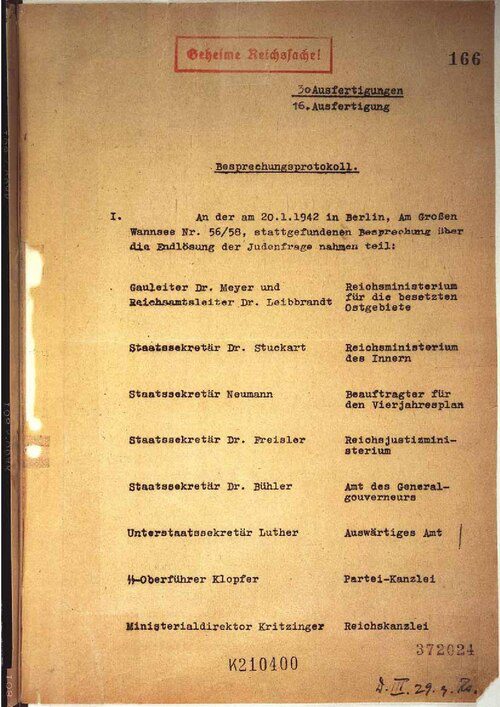
First page of Copy 16 of the Wannsee Protocol — Marked “Secret Reich Matter.” Courtesy of the Museum and Educational Site, House of the Wannsee Conference.
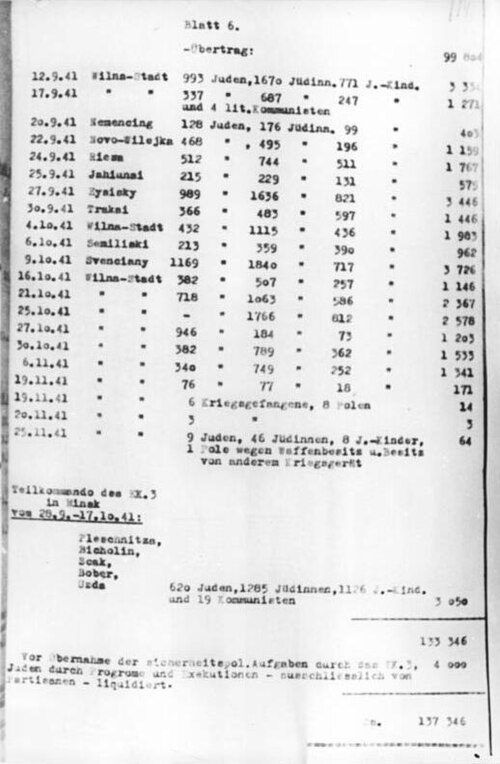
The Jäger Report Execution Ledger. Source: German Federal Archive.
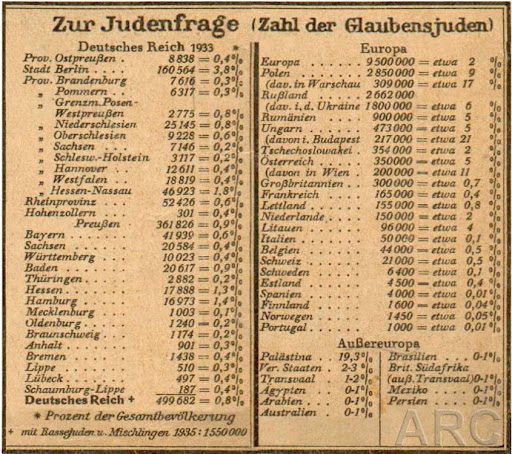
The Korherr Report is a 16-page document on the progress of the Holocaust in German-controlled Europe, delivered to Heinrich Himmler on March 23, 1943. Source: Deathcamps.org.
Key Archival Records & Empirical Facts
- The Wannsee Protocol (January 20, 1942): Minutes from a secret 90-minute conference held in Berlin, chaired by SS-Obergruppenführer Reinhard Heydrich and attended by 15 high-ranking Nazi civilian and SS state secretaries. Copy No. 16 (belonging to diplomat Martin Luther) was recovered by American prosecutors in 1947. The document outlines the administrative logistics for deporting and destroying approximately 11,000,000 European Jews across 31 countries.
- The Einsatzgruppen Operational Situation Reports: Contemporary field reports sent directly to the Reich Main Security Office (RSHA) in Berlin by four mobile killing units (Einsatzgruppen A, B, C, D) operating in occupied Soviet territory.
- The Jäger Report (Karl Jäger, SS-Standartenführer): Sheet 6 of this report documents the systematic execution of 137,346 people (including 55,556 women and 34,464 children) in Lithuania between July 2 and December 1, 1941, logged by date, location, and casualty breakdown.
- Einsatzgruppe A Report (Franz Walter Stahlecker): Documented 229,052 executions in the Baltic states within the first six months of Operation Barbarossa.
- The Korherr Report (March 23, 1943): A 16-page secret statistical audit produced by Dr. Richard Korherr for Reichsführer-SS Heinrich Himmler. It recorded that between 1937 and late 1942, the European Jewish population under German authority had decreased by over 4 million individuals. Himmler explicitly returned the draft, instructing Korherr to sanitize the phrase Sonderbehandlung to read “durchgeschleust” (“passed through”) for submission to Adolf Hitler.
- The Höfle Telegram (January 11, 1943): An intercepted top-secret radio transmission sent by SS-Sturmbannführer Hermann Höfle to Adolf Eichmann. Decoded by British codebreakers at Bletchley Park, it recorded exact victim counts for Operation Reinhard extermination camps through the end of 1942:
- Bełżec: 434,508
- Sobibór: 101,370
- Treblinka: 713,555
- Majdanek (Lublin): 24,733
- Total: 1,274,166 victims.
Structural, Chemical, and Forensic Evidence
Denialist literature frequently asserts that gas chambers functioned exclusively as delousing installations designed to control typhus among camp populations. While Zyklon B (hydrogen cyanide deposited on diatomaceous earth carriers) was indeed utilized for garment pest control, surviving structural, architectural, and forensic evidence refutes the claim that high-capacity facilities served solely for sanitation.
Technical Differences: Delousing vs. Homicidal Gas Chambers
| Technical Metric | Standard Delousing Chamber | Homicidal Gas Chamber (Crematoria II/III) |
|---|---|---|
| Location | Above-ground, small capacity | Underground subterranean bunker (Leichenkeller) |
| Ventilation System | Basic convection / low volume | Forced industrial intake and extraction fans (Entlüftungsanlage) |
| Doors & Fixtures | Standard gasketed wooden doors | Gas-tight heavy steel doors with brass observation ports and rubber seals |
| Heating Elements | Radiators/heaters to elevate temperature for rapid gas release | Human body heat elevated ambient temperature; gas poured through ceiling shafts |
| Adjoining Infrastructure | Clothing racks and washrooms | Direct connection to motor-driven elevator shafts leading to crematoria incinerators |
Forensic Verification Points
- Architectural Requisitions: Invoices from the SS Central Building Administration (Zentralbauleitung der Waffen-SS und Polizei Auschwitz) explicitly order items such as “Gasdichte Türen” (gas-tight doors), “Geviertfenster” (gas inspection windows), and four wire-mesh introduction columns (Drahtnetzeinschiebevorrichtung) for dropping Zyklon B pellets into crowded underground spaces.
- Chemical Trace Residue: In 1994, the Jan Sehn Institute for Forensic Research in Kraków analyzed structural mortar samples taken from the ruins of Crematoria II and III gas chambers at Birkenau. Using microchemical cyanic acid determination, researchers detected high concentrations of cyanide compounds in the gas chamber walls, matching independent forensic analyses.
- Alternative Killing Technologies: Extermination centers operated under Operation Reinhard (Treblinka, Sobibór, Bełżec) and Chełmno utilized large stationary diesel/gasoline engine exhaust (carbon monoxide) or mobile gas vans (Gaswagen), as documented in the internal SS correspondence of Walter Rauff.
Demographics & Spatial Casualty Estimates
The estimate of approximately six million Jewish fatalities is a baseline calculated through rigorous demographic methodology, cross-referencing independent pre-war and post-war census data across European nations.
Pre-War European Jewish Population (1939):  9,500,000
Post-War European Jewish Population (1945):  3,500,000
Total Population Deficit:                    6,000,000
Breakdown by Execution Mechanism
| Category | Approximate Victims | Notes |
|---|---|---|
| Extermination camps (Auschwitz-Birkenau, Treblinka, Bełżec, Sobibor, Chełmno, Majdanek) | ~2.5–3 million | Includes Jews murdered primarily through gas chambers and other direct killing methods at purpose-built killing centers. |
| Mass shootings (Einsatzgruppen, police units, SS, and some collaboration by local forces) | ~1.5–2 million | Includes large-scale shootings throughout occupied Eastern Europe, especially in the Soviet territories. |
| Ghettos, forced labor, starvation, and disease | Hundreds of thousands to over 1 million | Includes deaths caused by deliberate Nazi policies of deprivation, overcrowding, forced labor, and starvation. |
| Other Nazi persecution systems (concentration camps, transit camps, prisons, death marches, executions) | Hundreds of thousands | Includes victims who died from forced labor, executions, and evacuation marches, especially near the end of the war. |
Key Fact
“The six million figure is not calculated by simply adding one list of categories. Historians reconstruct the total using overlapping evidence: Nazi records, demographic studies, transport documents, local records, survivor testimony, and postwar investigations.”
Key Statistical Archives
- Deportation Registers (Transportlisten): Deutsche Reichsbahn railway billings meticulously cataloged civilian transports on a per-kilometer, per-passenger basis (charged at third-class passenger rates of 4 Pfennigs per kilometer for adults, half for children, billed to the SS).
- Pre-War/Post-War Census Verification:
- Poland: 3,300,000 Jews in 1939 → 380,000 Jews in 1945 (Loss: 90%)
- Greece: 77,000 Jews in 1941 → 14,000 Jews in 1945 (Loss: 82%)
- Netherlands: 140,000 Jews in 1940 → 35,000 Jews in 1945 (Loss: 75%)
- Global refugee registers (ICRC, UNRRA, HIAS) track survivor emigration routes to North America, Mandatory Palestine, and South America, confirming that untracked mass emigration cannot account for the missing population.
Conclusion
The Holocaust is one of the most thoroughly documented state-sponsored genocides in human history. Its certainty does not depend on an isolated document, a single testimony, or an individual archive. It relies on the convergence of distinct, mutually reinforcing streams of evidence: documentary, demographic, forensic, and structural. While legitimate historiographical debate continues regarding specific military logistics, institutional rivalries, and regional variations, the factual existence of the Holocaust is a settled historical matter supported by primary evidence.
To deny the Holocaust requires declaring millions of pages of captured German records, thousands of photographs, aerial reconnaissance, forensic soil sampling, pre- and post-war census data, and the unanimous testimony of both perpetrators and survivors to be a single coordinated forgery. It is not a historical debate; it is an ideological rejection of physical reality.