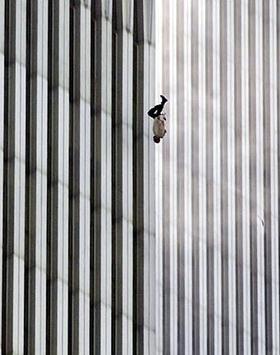
“The Falling Man” is to confront the rawest, most unshielded tragedy of September 11, 2001. Captured at 9:41:15 a.m. from the corner of West and Vesey Streets, the image shows an unidentified man plunging headfirst from the upper floors of the World Trade Center’s North Tower.
The attacks of September 11, 2001, produced one of the most extensively documented events in modern history. Thousands of photographs, recordings, eyewitness accounts, and news reports captured the destruction of the World Trade Center, the Pentagon, and the crash of United Airlines Flight 93. Among these images, one photograph became particularly significant in the historical memory of the attacks. Known as the Falling Man, the photograph depicts an unidentified individual falling from the North Tower of the World Trade Center. Taken by Associated Press photographer Richard Drew at approximately 9:41 a.m., the image became both a record of an extraordinary historical event and a subject of intense public debate concerning journalism, dignity, death, and collective memory.
A Photograph of Individual Loss
The photograph is historically significant because it presents September 11 from an individual perspective rather than through the destruction of buildings or the movement of crowds. Much of the visual documentation of the attacks emphasizes the scale of the catastrophe. The burning towers, enormous clouds of smoke, collapsing structures, and fleeing civilians communicate the magnitude of the event. The Falling Man, however, reduces that enormous historical event to the image of one human being. This shift in perspective is important because it reminds the viewer that the destruction of the World Trade Center was not simply an attack against buildings or a symbolic attack against the United States. It resulted in the deaths of thousands of individual people.
The Circumstances Inside the North Tower
The circumstances surrounding the photograph must also be considered carefully. The individual shown in the image was among those who were above the impact area of the North Tower during the attack. Conditions within the upper floors became increasingly dangerous as fire and smoke spread through the building. The precise circumstances surrounding the individual’s fall cannot be established from the photograph itself. It is therefore historically inappropriate to state with certainty whether the person intentionally jumped or whether the fall occurred involuntarily. The distinction is important because the photograph provides visual evidence of an individual falling, but it cannot independently establish the person’s intentions or psychological state.
Journalism and Ethical Responsibility
The publication of the photograph generated an important debate within American journalism. Newspapers faced the difficult question of how to document an unprecedented tragedy while respecting the dignity of those who died. Photographs showing people falling from the towers were particularly controversial because they presented death in a direct and individualized manner. Unlike photographs of damaged buildings, these images placed the viewer in immediate proximity to the human consequences of the attacks. Some newspapers subsequently limited the publication of such photographs because of concerns about the emotional impact on readers and the dignity of the victims and their families.
Historical Documentation and Public Memory
The controversy surrounding the Falling Man demonstrates the tension that can exist between historical documentation and public sensitivity. Journalism has a responsibility to document events of major public significance, but documentation also raises ethical questions when the subject is an identifiable or potentially identifiable human being experiencing death. The photograph therefore became more than a piece of visual evidence. It became part of a broader debate about how societies remember traumatic events and how images influence collective memory.
The Human Meaning Behind the Statistics
The Falling Man also illustrates the difficulty of representing mass death. Statistics can communicate the scale of a tragedy, but numbers cannot fully communicate the individual experiences contained within them. The 2,977 people killed in the September 11 attacks were not simply a numerical total. Each individual had a personal history, family relationships, occupations, friendships, and expectations for the future. Historical remembrance becomes more meaningful when the scale of the event is connected to the individual lives that were lost.
The Importance of Uncertainty
In this context, the photograph’s significance does not depend upon knowing the identity of the person depicted. The uncertainty itself reinforces the broader historical reality that thousands of people became victims of an event whose full human dimensions could never be represented by a single image. The absence of a confirmed identity also demonstrates the importance of historical discipline. Researchers and journalists must distinguish between what can be demonstrated through evidence and what remains uncertain.
The Falling Man and Historical Memory
The Falling Man has consequently remained an important part of the visual history of September 11. Its significance lies not only in the physical act depicted but in the questions that the photograph raises about mortality, historical memory, journalism, and human dignity. It challenges viewers to consider the individuals who were present inside the World Trade Center rather than viewing the attacks solely through images of architecture and destruction.
More than two decades after the attacks, the photograph continues to demonstrate the power and limitations of visual documentation. A single image can preserve a moment of history, but it cannot explain everything that occurred before or after that moment.
It cannot reveal the identity of the person with certainty, establish his intentions, or communicate the complete experience of those inside the tower. What it can do is preserve evidence of the human consequences of September 11. For that reason, the Falling Man should be understood neither as a spectacle nor simply as an image of death. It should be understood as a historical document that places an individual human life within one of the defining tragedies of the early twenty first century. Its enduring significance comes from this connection between the individual and the historical event. The photograph reminds us that behind the statistics, buildings, political consequences, and historical narratives of September 11 were thousands of people whose lives ended that morning. Remembering the event responsibly requires preserving that human dimension while distinguishing established historical evidence from speculation. The Falling Man remains powerful precisely because it forces that confrontation with the individual reality of a catastrophe that is often remembered primarily through its enormous scale.