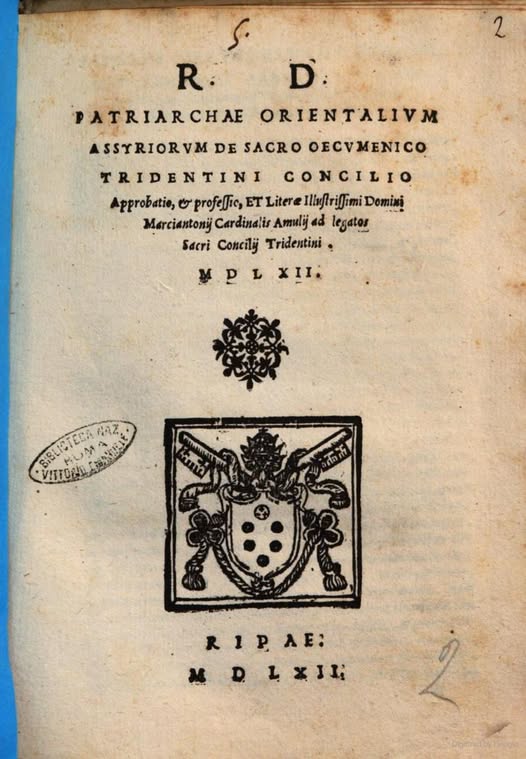
If you dig deep enough into the Vatican’s Secret Archives, buried among dusty late-Renaissance diplomatic letters, you’ll find a short Latin document dated 1562. On the surface, it looks like standard 16th-century church paperwork issued by Pope Pius IV.
But to historians—and to the indigenous people of the Fertile Crescent—this paper carries massive weight.
Beyond its theological significance, the 1562 document stands as an indisputable, 16th-century European record of Assyrian ethnic and historical continuity. Written long before modern nationalism took root, it proves that the people living in Mesopotamia never forgot who they were, and neither did the world around them.
What Actually Happened in 1562?
To understand why this document exists, you have to look back ten years earlier, to 1552.
For centuries, the ancient Church of the East had been operating across Mesopotamia, Persia, and parts of Asia. But a major crisis was brewing over how its top leader (the Patriarch) was chosen. By the 16th century, the office had become strictly hereditary, passing from uncle to nephew—often putting young, inexperienced family members in charge.
Fed up with the system, a group of local clergy met in Mosul in 1552 and elected a monk named Yohannan Sulaqa as an alternative patriarch. Sulaqa traveled all the way from the mountains of northern Iraq to Rome to secure official recognition from the Vatican.
After Sulaqa was assassinated back home by regional rivals in 1555, his successor, Abdisho IV Maron, made his own journey to Rome in the early 1560s to solidify the alliance.
In 1562, Pope Pius IV issued the official papal bull recognizing Abdisho IV.
Why This Document Proves Assyrian Continuity
For centuries, critics and outside skeptics have claimed that modern Assyrians only started using the “Assyrian” name in the 19th century due to European archaeologists and Western missionaries.
The 1562 Vatican decree blows that myth completely out of the water.
1. The Written Name: “Patriarch of the Assyrians”
When Renaissance scribes wrote up the official Latin decree in 1562, they didn’t invent a title out of thin air. They recorded the identity presented directly by Abdisho IV and his delegation from Mesopotamia.
The official papal document explicitly addresses Abdisho IV with titles recognizing him over the Assyrii—the Assyrians.
This wasn’t a sudden 19th-century label. In 1562, three hundred years before modern archaeology excavated the ruins of Nineveh and Nimrud, the indigenous people of Mosul, Diyarbakır, and the Hakkari mountains were already officially documented by foreign powers under their ancestral identity.
2. Geographic and Demographics Footprint
The document lists the specific towns, mountain districts, and monasteries under Abdisho IV’s jurisdiction. It maps out an indigenous population living in the exact same heartland—along the Tigris River, the Nineveh Plains, and northern Mesopotamia—where their ancient ancestors built temples, carved relief sculptures, and farmed thousands of years earlier.
3. A Living Lineage, Not an Archaeological Discovery
The 1562 record shows that the connection to ancient Mesopotamia wasn’t something dug out of the dirt by Western museum collectors. The people living in the 1500s were actively maintaining an unbroken chain of language (Aramaic/Surayt), oral history, and ancestral self-identification that stretched back through the Middle Ages straight into antiquity.
The Broader Impact Across Mesopotamia
The issuing of the 1562 document didn’t just record history; it altered the social and political landscape of the Middle East for centuries to come.
The 1552 Schism & Lineage Split
The historical split within the Church of the East reshaped the ecclesiastical hierarchy of Mesopotamia. The flow below traces how internal disputes over hereditary succession led directly to formal recognition by Rome in 1562.
-
1552 Schism in the Church of the East
-
Core Issue: Dissatisfaction with hereditary patriarchate succession (uncle to nephew).
-
Initial Divergence: The traditional hierarchy split into two distinct factions.
-
-
Faction A: Traditional Lineage (Hereditary Patriarchate)
-
Leadership: Patriarch Shimun VII Ishoʻyahb and successors.
-
Position: Rejected union with Rome; maintained traditional hereditary succession in the Hakkari mountains.
-
Historical Outcome: Evolved into the modern Church of the East Lineage (Assyrian Church of the East).
-
-
Faction B: Sulaqa’s Faction (Pro-Union Group)
-
Leadership: Yohannan Sulaqa (consecrated 1553) succeeded by Abdisho IV Maron.
-
Position: Sought external legitimacy and communion with the Holy See in Rome.
-
Turning Point (1562): Pope Pius IV issued the 1562 Papal Bull, officially confirming Abdisho IV Maron as Patriarch.
-
Historical Outcome: Evolved into the modern Chaldean Catholic Lineage (Chaldean Catholic Church).
-
1. Institutional Stabilization
While Sulaqa’s initial trip to Rome in 1553 set the process in motion, the 1562 decree proved that the alliance wasn’t a temporary fluke. It gave administrative backing to Abdisho IV’s followers, laying the structural groundwork for what eventually developed into the Chaldean Catholic Church.
2. A Bridge to the West
By establishing formal channels with Rome, the local population gained a rare direct line of communication to Western Europe. Over the next two centuries, this relationship brought European printing technology, educational networks, and diplomatic contacts into the region—though it also created tension with Ottoman authorities who viewed Western ties with suspicion.
Why a 460-Year-Old Document Still Matters Today
It’s easy to look at 16th-century religious decrees as dry, irrelevant paperwork. But for the modern Assyrian, Chaldean, and Syriac communities, the 1562 document is a vital piece of living proof.
-
It settles the identity debate: It provides hard primary-source evidence that the Assyrian identity was alive, recognized, and officially documented in the 1500s.
-
It explains modern demographics: You can’t understand why the modern community is divided into different church denominations today without tracing the paper trail that started in 1552 and was sealed in 1562.
-
It highlights sheer resilience: Through political assassinations, imperial wars, and geographic isolation, the indigenous people of Mesopotamia navigated global diplomacy to keep their heritage intact.
The 1562 document isn’t just an old religious text. It is a paper receipt from history—proving that through every empire, shift, and century, the Assyrian story never stopped.