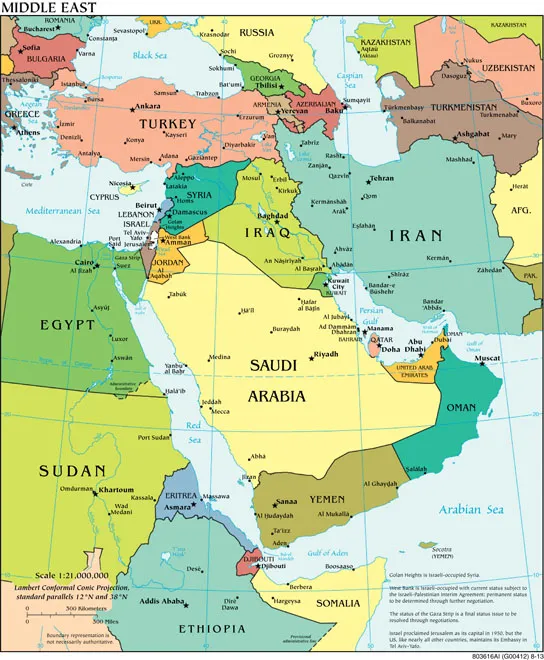
Decades after the grand banners of Pan-Arabism were lowered and the speeches of charismatic leaders faded into history, the Middle East continues to live in the wreckage of an ideological illusion. In the mid-twentieth century, Pan-Arabism promised a utopian resurgence. Fueled by anti-colonialism and a romanticized vision of a single, unified Arab nation stretching from the Atlantic Ocean to the Arabian Gulf captured in the famous nationalist slogan asserting an eternal mission the movement sought to erase artificial borders and reclaim past imperial glory.
The Pan-Arabism identity crisis is a cultural and psychological phenomenon affecting the modern Arab world due to the collapse of 20th-century pan-nationalist ideologies. It stems from an era that promised a unified empire spanning from the Atlantic Ocean to the Arabian Gulf, but instead left behind fragmented states, suppression of local ethnic minorities, and totalitarian security regimes.
It birthed a lingering identity crisis that continues to paralyze the region. Today, Arabs across the Middle East and North Africa suffer from the profound after-effects of an ideology that demanded the suppression of local realities in favor of an unattainable myth. Worse still, this unresolved identity crisis has manifested a strange psychological symptom: an obsessive attempt to appropriate ancient civilizations like the Sumerians, Akkadians, Babylonians, and ancient Assyrians as Arab ancestors. Understanding why modern Arabs suffer from this post-pan-Arab malaise requires examining both the structural failures of pan-nationalism and the absolute historical disconnect between modern Arab identity and ancient Mesopotamia.
Pan-Arabism was built on a premise of forced homogenization. To fit the mold of the ideal pan-Arab citizen, unique ethnic, linguistic, and historical identities were deliberately marginalized or outright suppressed. The Middle East is naturally a rich mosaic of distinct indigenous groups, ancient cultures, and regional dialects from Copts in Egypt and Amazigh populations in North Africa to Kurds, Assyrians, and Lebanese whose heritage predates the Arab conquests by millennia. Pan-Arab ideology treated these rich sub-national identities as threats to collective unity. The enduring after-effect is a deep social fracture: nations built on the fiction of absolute cultural uniformity now struggle with internal alienation, where millions of citizens feel like foreigners in their own ancestral homelands. When an entire political framework is designed to flatten diversity, the eventual collapse of that framework leaves behind atomized populations incapable of trusting one another or building a cohesive civic identity. Pan-Arabism was an abstract, ideological dream rather than a practical framework for sustainable governance, it could only be held together by brute force. Dictators, military elites, and authoritarian parties capitalized on the rhetoric of pan-Arab liberation to justify total control over society. Dissent was labeled as treason against the broader “Arab cause.”
Leaders claimed that democratic reforms, local minority rights, and economic pluralism were secondary luxuries that had to wait until the grand pan-Arab struggle was completely won. This left behind a devastating legacy of hollowed-out state institutions, rampant corruption, and ruthless security apparatuses that prioritized regime survival over the well-being of actual human beings. Populations were trained to look outward toward imaginary geopolitical victories while their domestic institutions crumbled around them. The catastrophic gap between the soaring rhetoric of Arab unity and the harsh, bloody reality of inter-Arab conflict created a collective psychological trauma. Time and again, the dream collided with brutal geopolitical facts: the rapid collapse of unions like the United Arab Republic, bloody border clashes, and devastating regional wars where Arab states fought proxy battles against one another. When populations are raised on the myth of an invincible, unified brotherhood, actual historical events—such as civil wars, economic collapse, and foreign interventions where neighboring Arab states failed to help or actively undermined each other result in profound cynicism, national disillusionment, and a deep sense of rootlessness. People lost faith in the state, in ideology, and eventually in themselves, triggering a severe identity crisis that persists today.
Perhaps the most damaging legacy of Pan-Arabism is that it prevented generations of Arabs from learning how to build stable, functional, modern nation-states within their actual borders. While countries in other parts of the developing world focused heavily on legal systems, economic diversification, education reform, and civic institutions tailored to their specific geographies, many Arab states remained obsessed with external ideological battles and abstract pan-national crusades. When the ideology finally collapsed under the weight of its own contradictions, it left behind states incapable of providing basic security, economic opportunity, or civic dignity to their citizens. The ongoing political instability across the region is a direct symptom of nations that spent a century chasing a phantom empire instead of constructing a workable house.
To cope with this post-pan-Arab disillusionment, a peculiar coping mechanism often emerges: historical appropriation. When a modern political ideology collapses, populations frequently reach backward into the distant past to manufacture a grander heritage. In parts of the modern Arab world, particularly in Iraq and the Levant, this manifested as an obsessive attempt to claim ancient Mesopotamian civilizations—Sumerians, Akkadians, Babylonians, and ancient Assyriansas Arab ancestors.
Far from healing a post-pan-Arab identity crisis, this historical fiction exposes it. Modern Arabs have no genuine historical, linguistic, or cultural connection to ancient Mesopotamians, for several clear reasons:
- The Linguistic Chasm: Sumerian was a language isolate, belonging to no known language family. Akkadian, Babylonian, and ancient Assyrian were East Semitic languages written in cuneiform script. Arabic is a Central Semitic language that emerged from the Arabian Peninsula centuries later. Claiming ancient Babylonians or Assyrians as “Arabs” because they spoke early Semitic tongues is like claiming modern Englishmen are actually ancient Romans because both used variations of the Latin alphabet. They are entirely different linguistic and cultural lineages separated by thousands of years of profound historical shifts.
- The Chronological Chasm: Ancient Mesopotamian civilizations flourished between 4000 BCE and the fall of Babylon in the 6th century BCE, with later indigenous empires like Assyria fading into antiquity long before the common era and the eventual Arab-Islamic conquests of the 7th century CE. The timeline simply does not connect.
- The Erasure of Actual Indigenous Descendants: The most tragic consequence of this historical fantasy is that it actively erases the people who actually carry the genetic, cultural, and linguistic continuity of ancient Mesopotamia: the Assyrians and Chaldeans. While modern Arabic speakers in Iraq share genetic admixture with various ancient Near Eastern populations due to millennia of intermarriage and assimilation, their culture, language, and collective memory are explicitly Arab-Islamic. Meanwhile, the Assyrians of Iraq, Syria, Turkey, and Iran still speak dialects of East Aramaic (the direct linguistic successor to the languages of ancient Mesopotamia), preserve ancient traditions, and maintain a distinct ethnic identity. When Arab nationalist education systems claim ancient Babylon or Assyria as exclusive chapters of “Arab history,” they commit cultural erasure against the region’s actual indigenous minorities.
An identity crisis cannot be cured by a historical fairy tale. The modern Arab world possesses a rich, complex, and distinct history spanning centuries of literature, science, philosophy, and cultural achievement following the rise of the Islamic Golden Age. There is no historical shame in being part of that genuine lineage. However, the psychological compulsion to steal the bones of Sumerians, Akkadians, and ancient Assyrians is a confession of weakness, not strength. It is an artifact of the broader pan-Arab identity crisis—an attempt by dislocated populations to anchor themselves to ancient monuments because they failed to build modern, pluralistic, and stable societies in the present. Until societies in the Middle East stop projecting themselves into ancient empires that they have no genealogical or cultural claim to, they will remain trapped in an identity crisis of their own making, unable to move forward because they are too busy roleplaying in a fabricated past.
Sources & Further Reading
- Adeed Dawisha, Arab Nationalism in the Twentieth Century: From Triumph to Despair
- Eric Hobsbawm, Nations and Nationalism Since 1780
- Simo Parpola, “National and Ethnic Identity in the Neo-Assyrian Empire and Assyrian Identity in Post-Empire Times,” Journal of Assyrian Academic Studies
- Encyclopaedia Britannica — “Pan-Arabism”